The Tongue of Time
Laudatio for Liza Lim — Mauricio Kagel Music Prize — Marco Blaauw
Greeting
Dear Liza, dear Daryl, sehr geehrte Frau Dr. Firmenich, sehr geehrter Herr Dr Steinmann, dear friends,
The lion
A green lion eats the sun.
We have just heard it. One player, one instrument with two bells. One bell open and steady, the other muted and searching. And above it all, this title. A green lion that eats the sun.
It makes no sense. And our brain does what it always does: it looks for something to hold on to. An anchor. A simple explanation.
Liza doesn't give us one. She gives us an image. And she trusts us to do something with it — to think, to dream, to let the absurd work on us.
In alchemist imagery, the green lion can represent raw, instinctive desire. A force that wants to swallow the sun — our reason, our ego. But a lion that eats also digests. Something goes in, and something else comes out. A transformation, a metabolism.
And that is the very word Liza uses for her own work. She experiences composing, she says, as something metabolic. Not as a plan you carry out, but as something that happens through you.
She wrote this piece in 2014, for Melvyn Poore and his double-bell euphonium. Tonight we heard it on the double-bell trombone. And half of it she wrote at Boston airport, during a seven-hour delay. Noise, announcements, frustrated passengers all around. And Liza was completely focused. She told me afterwards: “Nothing could disturb me. Nothing could touch me. The music is making you, and you are making the music.”
Nothing to say
I wish I could say the same about writing this speech.
When I was asked to speak tonight, I said yes immediately. Of course. It is a great honour. And then I sat down to write — and I froze. Like a rabbit in the headlights.
There is so much to say about Liza Lim. Too much. More than thirty years of music, every piece its own small cosmos — and all of it together a force of nature. I wrote little fragments for hours, for days…nothing flowed.
And I thought of John Cage, in his Lecture on Nothing. He wrote: “I have nothing to say, and I am saying it.”
But there are two kinds of nothing. One that paralyses you. And one that is full of trust. I will come back to that.
Shock and familiarity
My first real encounter with Liza's music was a shock. It was her opera The Navigator. I understood almost nothing. But the images and sounds stayed with me. For a long time they kept playing in my head. I still couldn't tell you exactly what they meant. But they became familiar. I started to recognise them in my everyday life.
At the centre of that opera is a figure: the Angel of History, after Walter Benjamin, who took this image from Paul Klee’s work Angelus Novus. An angel blown into the future by a storm. It can only look backwards, and it sees the catastrophes of the past piling up in front of it. And that storm, Benjamin says, is what we call progress.
Liza describes this angel as a figure “moving with its back to the future”. And she asked herself: what would the voice of that strange knot of time sound like?
A part of the answer was a trumpet. From the opera came Wild Winged One, an aria for solo trumpet, written for Tristram Williams.
In 2010 I began to work on it. We talked on Skype — from my home in Nijmegen to her home in Melbourne, half the world apart. I had many questions. How fixed is this? How precisely is the sound already written into the notation — and how much is left open, to unfold only when you play?
Instead of answers, Liza gave me questions back — very precise ones. And they gave me courage to follow my own feeling for the piece — still tentative, still unsure, but already adventurous.
Since then I have played Wild Winged One many times. And it is still changing, from one performance to the next. The notation is exact: pitches, microtones, ornaments, rhythm, dynamics, everything. But the score as a whole is a figure. A character. It keeps growing every time you speak its language out loud — like an actor who repeats a monologue, again and again, and finds new colours each time.
Does that ever end? Not with music this well made. There is always something left to discover.
When Liza composes, the pages go up on the wall of her study. She steps back and looks at them, as if she could see time. Because for her, time is not something you count. In her own words: “Time is not counted, but is living and growing.”
A voice from the past
In 2022, I was able to commission a new piece from Liza for my Global Breath Composers Project — supported, among others, by the Kunststiftung NRW.
Our conversations led us to the Vallabrix’ ceramic horn: this replica of an instrument more than four thousand years from the late Stone Age. One of the earliest lip-blown instruments made by human hands. An ancestor of the trumpet. Strictly speaking, it can play one good note.
Tonight we are in Kolumba — a house that Peter Zumthor built around the chapel of the Madonna in the Ruins, above excavations of Roman settlement as well as evidence of much earlier stone age settlement. So much time has passed here, and all of it is still present.
Tooooot
So why would anyone make such a thing, when nature was full of horns? It must have been for communication. But communicating what? With whom? And what happens to us, today, when we hear it?
Liza looked at it and said: “It's a horn. Or a lump of earth with a hole. The earth with a mouth. A tongue.” The piece became Shallow Grave.
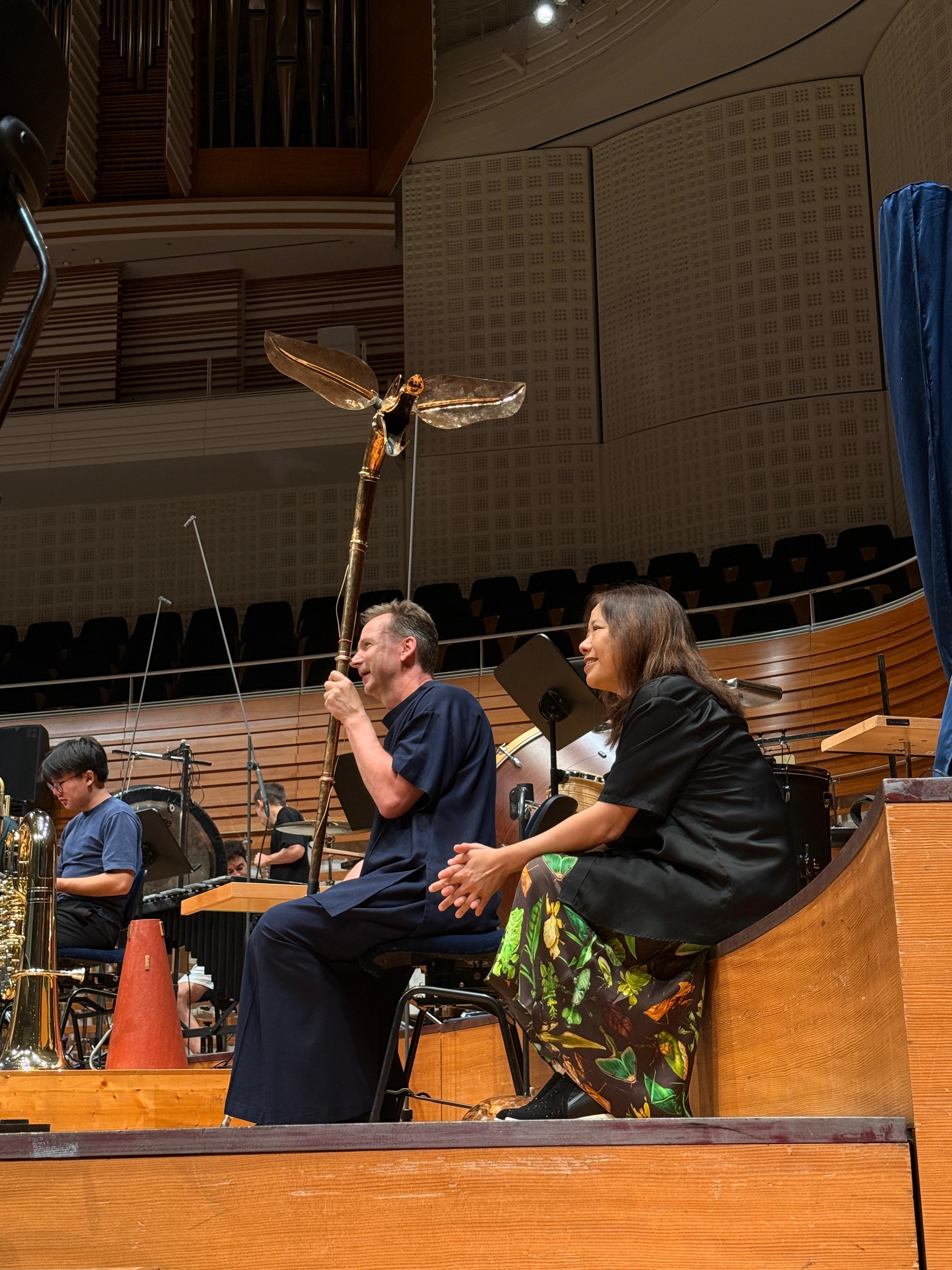
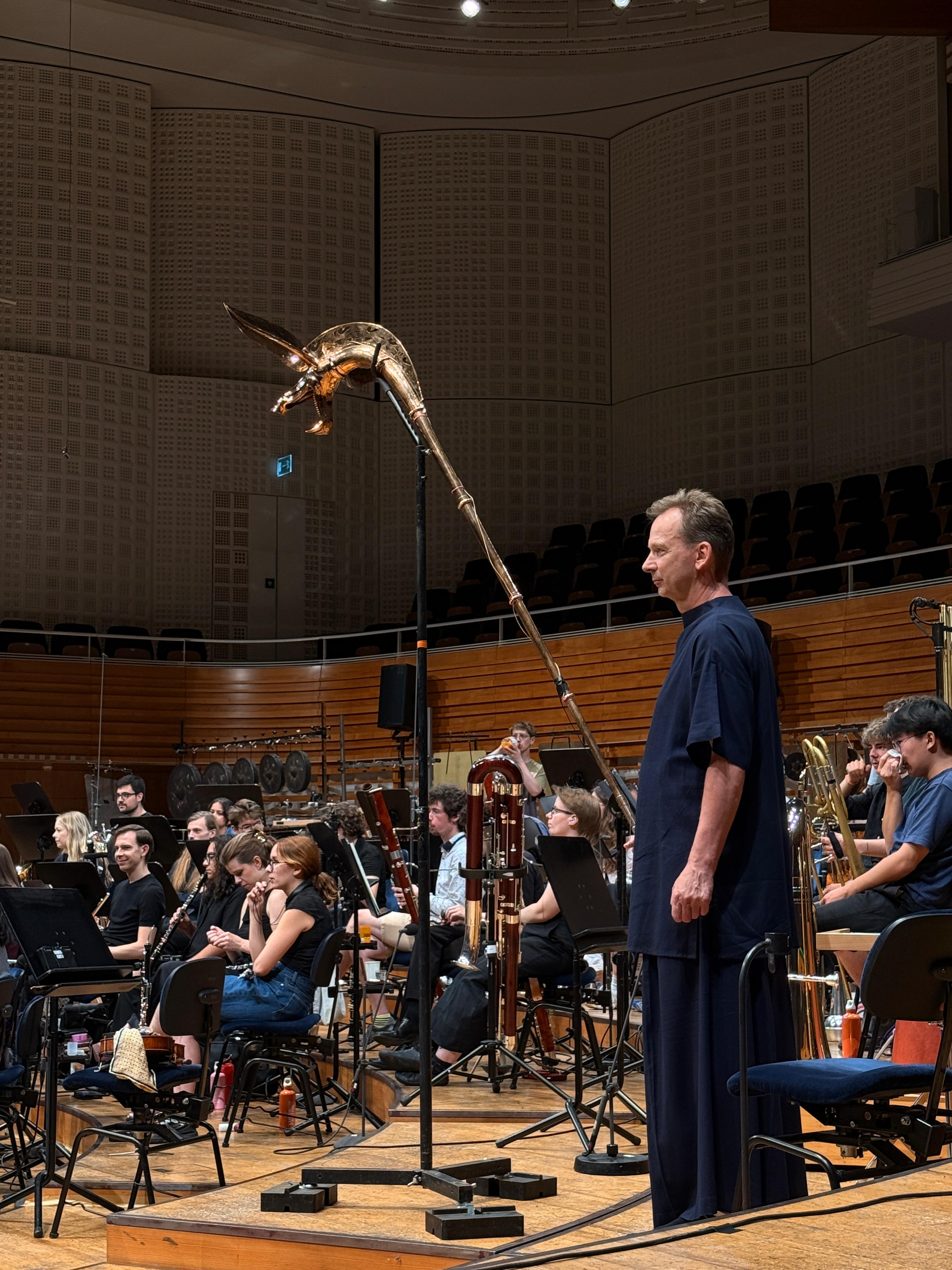
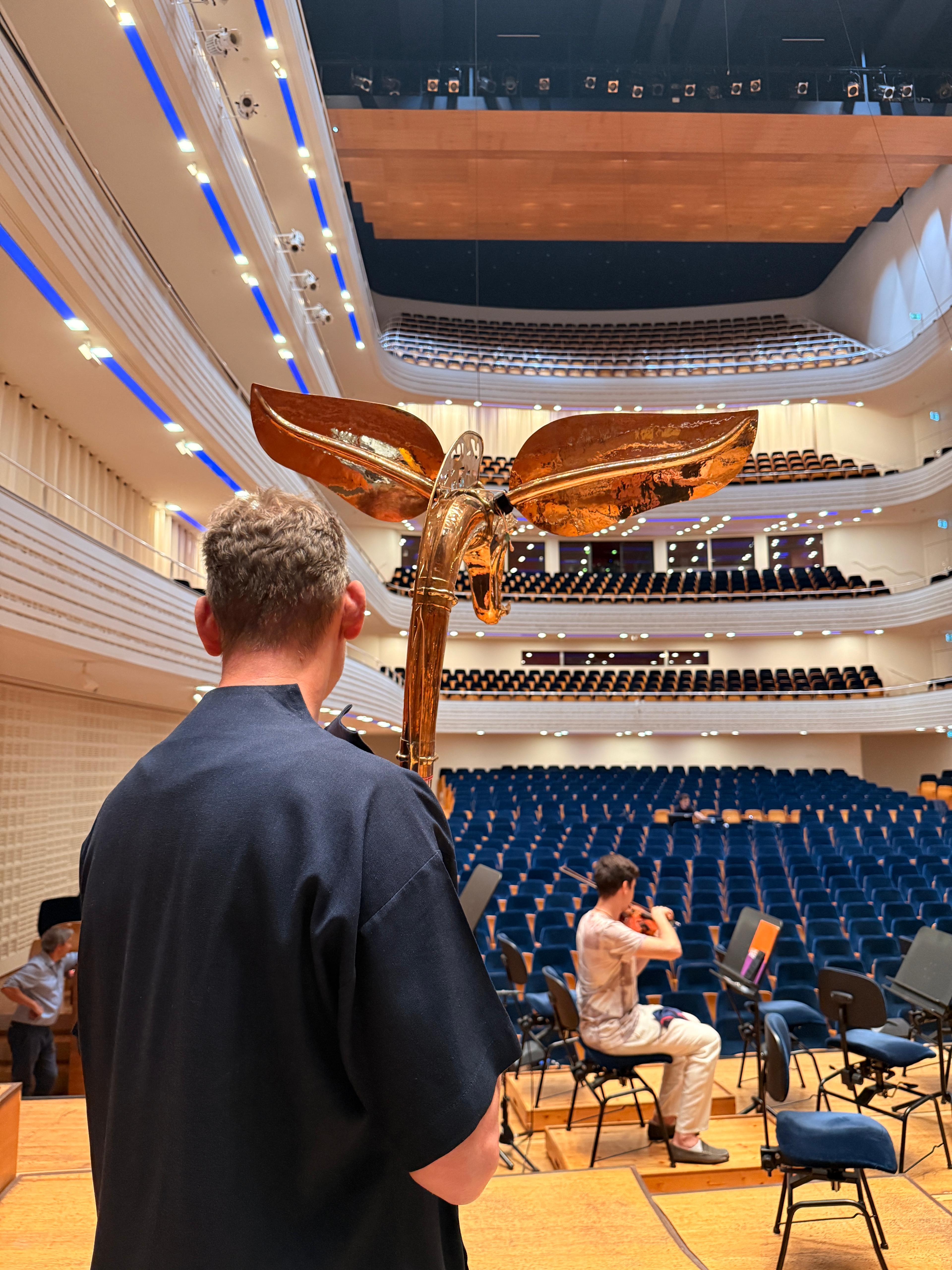
Our next project was for the Lucerne Festival. Liza was commissioned by Roche, to write a piece for orchestra. And the voice she chose was the carnyx. A Celtic trumpet, more than two thousand years old, with the head of a wild boar. This one, here. ⟨point to the carnyx⟩ An exact copy of an instrument that came out of the earth in 2004.
In 2025 we travelled together to the places in South France, where this instrument comes from. We filmed, we talked a lot. And we were silent together a lot. When the journey began, Liza had no idea at all what she would write. She wanted to see the land, meet the people, hear the first sounds.
That was her nothing. Not the frozen nothing of a rabbit in the headlights. A nothing full of trust. Curious about what might happen.
In December the first sketches arrived. Photos of pages on her wall. The movement was already there. But it was too early for me play them... The carnyx stood in my room and stared at me. A rather stern look — as you can see. ⟨look at the carnyx⟩ I had to prepare, physically and mentally.
And then the finished score came. The part of the carnyx looked good! Full of colours, full of movement. But never forced. Liza's hand follows what the instrument can do. Not for a single moment does she push it into an unnatural corner. Her music is always an invitation, never a command.
At the premiere this summer, I walked through the audience into the hall with the carnyx. As I leaned back to play the first notes, I heard giggling all around me. Surprised (?), shy (?), a little awkward (?).
A wild boar from two thousand years ago had just walked into a modern concert hall.
And of course, out came the smartphones at once. The carnyx is quite a photogenic macho.
But then the strings of the orchestra welcomed it — with an offering of coins. Hundreds of coins were dropped on the stage. A gesture of respect and of thanks. And also a way to deal with that strange tear in time that all of us had just felt.
For Liza, ritual is a kind of play — with humour and with complete seriousness at the same time.
Ritual
Through ritual we can establish communication with the world around us, with humans, and with everything that is not human: the earth, the land, an instrument that was silent for two thousand years. Liza takes these voices seriously — as partners in conversation. Perhaps that is exactly the kind of listening our world needs now, facing wars and the consequences of the fast changing climate.
Life-giving
In September, during a discussion panel at the Klangspuren festival in Tyrol, Liza talked about her ways into the creative flow — her practices, her training. She told us that she had kept up a meditation practice for a long time, and then stopped — because for her it no longer felt “life-giving”.
That word stayed with me. I think it is the best word for how Liza works with people. In rehearsals she is always there as a listener. Curious how the musicians will read her notation — her invitation. She is not a composer who controls, who chases one ideal sound she has built in her head. She trusts the process. And that is contagious. It gives everybody the courage to step into a new world.
She knows how much that matters. When she was thirteen, a music teacher gave her the space to write for the school orchestra. Forty years later, she said, that one opportunity is still having an impact.
She sees her own success in the same way — this prize, her chair in Sydney, her research project “resonant earth, music, ecology and climate justice”, all the commissions and performances. She wants to be — as she told me — “a channel” that passes all of this on, to the next generation that needs it to start out in life.
The tongue of time
The green lion. The angel with its back to the future. The lump of earth with a tongue. The wild boar from two thousand years ago. Again and again, Liza gives a voice to time itself. Time that is not counted, but living and growing.
So what can we can we expect in near and far future? In an interview with ABC national radio last summer Liza answered: “I want to be even more surprised! So, I have to do things now, that surprise 20 years down the track…”
Dear Liza, I am sure you will be. And so will we.
In the film earlier, Liza talked about how important Mauricio Kagel's music theatre was to her — above all because the music is always at its centre.
Perhaps this is where the connection lies. With Kagel, making music itself becomes the scene, with wit and with seriousness. It is the same with Liza: when coins are offered, or when the carnyx enters the hall, it is never just an effect. It comes from the music — and leads back to it.
Dear Liza, congratulations on the Mauricio Kagel Music Prize.